info@pearlelitetours.com 24X7 Call 9911151027

Brahma Sarovar, Haryana
Not only water but the salvation of the spirit
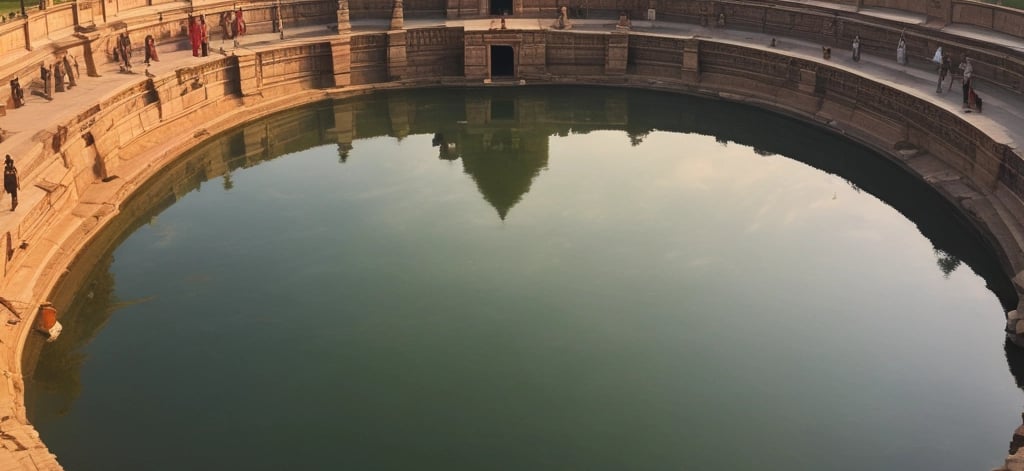
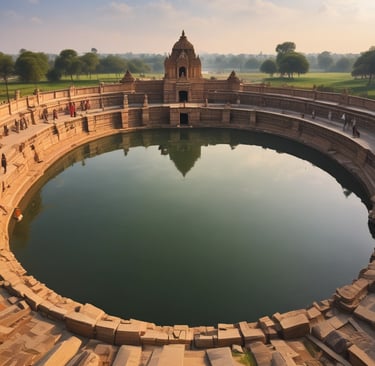
The ancient water pool, the largest ‘sarovar’, it was the cradle of civilization when Brahma fashioned the universe from Kurukshetra! Welcome to Brahma Sarovar, one of the most holy water bodies in Hinduism, where devotees from all over the world gather to bathe for purity.
Spanning 3600 feet in length, 1500 feet in width, and 45 feet in depth, it ranks as one of Asia’s largest artificial ponds. Legend has it that Brahma began creating the universe here in Kurukshetra by means of a grand yajna. Consequently, the waters of Brahma Sarovar in this sacred land were essential to the inception of existence itself.
From Abul-Fazl of Emperor Akbar’s court who likened Brahma Sarovar to a miniature sea, to Al Beruni who documented it in his 'Kitab-ul-Hind' in the eleventh century AD, travelers throughout history have admired its vastness in their writings.
Even the Mahabharata references it, narrating how Duryodhana sought sanctuary in its waters at the conclusion of the war, protected by the divine Dharam. The tale of the Mahabharata is so intricately interwoven here that the ghats of the sarovar bear the names of many of its notable figures. Once known as Ramahard and Samanta Panchaka, it’s also associated with Parshuram, an incarnation of Vishnu.
People gather here during solar eclipses, convinced that immersing themselves in its waters brings the blessings equivalent to thousands of horse sacrifices. Come too, for the salvation of your soul!
The myths and the festivities
According to local legends, King Kuru, the forebear of the Kauravas and Pandavas, excavated this tank. It is claimed that Brahma himself conducted his initial sacrifice here.
In the center, you will find an island commemorating Yudhistir’s triumph in the Mahabharata war, adorned with a towering monument accessible by a concrete bridge. In this vicinity, there's also a large black stone chariot of Lord Krishna and Arjuna. Nearby lies Draupadi’s well, where it’s said she cleansed her hair with the blood of Dushasana. On its northern shore stands Sarveshwar Mahadev, a shrine to Lord Shiva, thought to have been established by Brahma.
Every year, during the last week of November and early December, the Gita Jayanti celebrations grace the shores of the sarovar, highlighted by the enchanting ceremony of 'deep daan'−the floating of lamps−and soul-stirring aarti. This sacred period also welcomes migratory birds from far-off lands, enhancing the natural charm of the sarovar.
Beyond the sacred waters
Brahma Sarovar is surrounded by many attractions that enrich its spiritual essence. Adjacent to Brahma Sarovar are other sites such as the Birla Gita Mandir, and Baba Nath's haveli and temple. There's also a Buddha Stupa complex located next to Kurukshetra University.
A short distance from Brahma Sarovar is Jyotisar, regarded as the birthplace of the Bhagavad Gita. Another notable water body close to Brahma Sarovar is Sannihit Sarovar, revered as one of the holiest lakes in Hinduism.
Brahma Sarovar invites visitors to pause, reflect, and connect with the divine wisdom that courses through its waters. You must visit at least once to experience its serenity.
Major Airports :
Chandigarh Airport (IXC)
Nearest Railway Station :
Kurukshetra Junction (KKDE)
Timings
Opening time - 06:00 AM
Closing time - 08:00 PM
Pearl Elite Tours
7A/43, W.E.A, Karol Bagh,
New Delhi-110005 INDIA
Reach Us
919911151027
info@pearlelitetours.com
www.pearlelitetours.com


Secured payment gateway
Powered by ResAvenue